Providence and the idea of freedom
Rhode Island began as an argument about conscience. Roger Williams founded Providence in 1636 as a refuge from religious coercion, and the 1663 royal charter made that freedom law — a radical experiment whose marks are still legible on College Hill and Smith Hill.
The exile who built a refuge
Roger Williams was banished from the Massachusetts Bay Colony in 1635 for his religious and political views, including his insistence that civil authorities had no business policing belief. In 1636 he settled at the head of Narragansett Bay on land obtained from the Narragansett people and named the place Providence.
Williams built the settlement around what he called liberty of conscience — the principle that a person's faith was not the government's to compel. That idea, ordinary now, was close to heresy in 17th-century New England, and it set Rhode Island apart from its Puritan neighbors from the start.
The charter that made it law
In 1663 King Charles II granted Rhode Island a royal charter that explicitly guaranteed religious liberty, making the colony the first to protect freedom of conscience in its founding law. The document let people 'hold and enjoy' their own religious views without state interference.
That guarantee is why Rhode Island drew people other colonies pushed out. The First Baptist Church in America traces its congregation to Williams and 1638, and Newport's Touro Synagogue — dedicated in 1763 — became the oldest surviving synagogue in the country.
College Hill and the life of the mind
The same tolerance shaped Providence's intellectual life. Brown University, founded in 1764, was the seventh college in the colonies and wrote freedom of conscience into its charter, admitting students without a religious test. Benefit Street, the 'Mile of History' below the campus, still carries one of the densest runs of preserved colonial and Federal architecture in the country.
The city's cultural institutions grew from that soil: the Providence Athenaeum, a membership library of 1836, and the Rhode Island School of Design, founded in 1877 as both a school and a museum, which keeps Providence a working center of art and design.
The marble statement on the hill
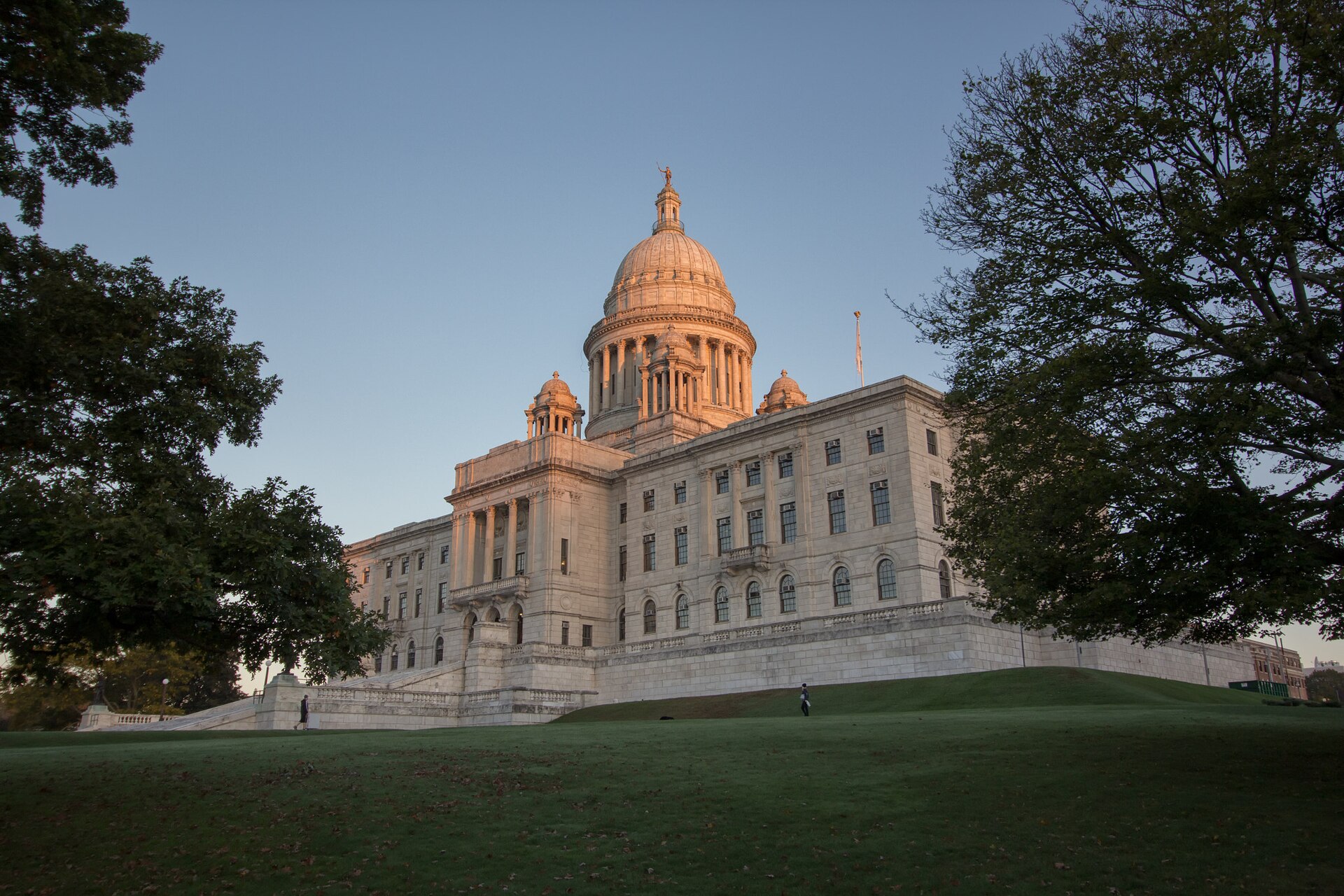
Providence's civic ambition is written in stone at the Rhode Island State House, completed in 1904 in white Georgian marble and crowned by one of the largest self-supporting marble domes in the world. For the smallest state, it is a deliberately outsized declaration.
It also marks how far the experiment had come: from a frontier refuge for the banished to a capital confident enough to build a monument to itself.
The harder ledger
Freedom of conscience sat alongside a brutal contradiction. Rhode Island merchants, centered in Newport and Bristol, came to dominate the North American share of the transatlantic slave trade in the 18th century, trading in the rum-and-enslaved-people economy that built much of the colony's wealth.
A serious visit holds both truths at once: the colony that pioneered religious liberty also profited deeply from human bondage. In 2020 voters removed the phrase 'and Providence Plantations' from the state's official name, one small reckoning with that past.
Reviewed source trail
- Roger Williams National Memorial (NPS) — checked 2026-06-19
- Rhode Island Department of State — the 1663 Charter — checked 2026-06-19
- Brown University — History — checked 2026-06-19
- Touro Synagogue National Historic Site — checked 2026-06-19