City guide · Blackstone Valley
Pawtucket: where American industry began
Pawtucket sits at the falls of the Blackstone River, where the water drops sharply enough to drive machinery. In the 1790s those falls powered Slater Mill, the first water-powered cotton-spinning mill in the United States, and the town grew into one of New England's early textile centers. The mill economy that started here also produced the country's first factory strike, in 1824, and the city today preserves that history through the surviving 1793 mill and the Blackstone River Valley National Historical Park.
The falls and the early settlement
The name Pawtucket comes from an Algonquian word meaning roughly "at the falls." The Blackstone River drops about fifty feet over a ledge of rock in what is now the center of the city, and that drop was the reason a settlement and later an industry took root here. For the Narragansett, Wampanoag, and Nipmuc peoples the pools below the falls were good fishing grounds, and the river marked a rough boundary between their territories.
European industry at the site began with iron, not cloth. In 1671 Joseph Jenckes Jr., who had learned the metalworking trade from his father in the Massachusetts Bay Colony, settled near Pawtucket Falls and built a forge and sawmill, drawn in part by a supply of bog iron ore nearby. His smithy was destroyed during King Philip's War in 1676 but was rebuilt.
Over the following century the falls drew more water-powered trades. By the time of the Revolution, the village around the falls supported sawmills, grist mills, oil and potash works, shipyards, and makers of muskets, anchors, nails, and farm tools. This concentration of skilled ironworkers and machinists, working beside dependable water power, is what later made it possible to build complex textile machinery on the spot.
Slater Mill and the start of American industry
Samuel Slater was born in Belper, Derbyshire, in 1768 and apprenticed in Jedediah Strutt's cotton mill, where he learned the Arkwright system of water-powered spinning in detail. British law at the time forbade textile workers and machinery plans from leaving the country, so Slater memorized the designs and sailed for the United States in 1789. In England he was later remembered by some as "Slater the Traitor" for carrying the technology abroad.
In Rhode Island, Slater partnered with the Providence merchant Moses Brown and with the firm of Almy and Brown, and worked with local mechanics, including the Wilkinson family, to reproduce the spinning machinery from memory. In December 1790 they got the machines running in a converted fulling mill, the first time cotton thread was spun on water-powered machinery in America. In 1793 the partners replaced that workshop with a purpose-built mill in Pawtucket, the building that still stands as Old Slater Mill.
The National Park Service describes that 1793 building as the first water-powered cotton-spinning mill in the United States and the region as the birthplace of the American Industrial Revolution. Slater is often called the "Father of the American Industrial Revolution," a label attributed to Andrew Jackson. It is worth noting that the mill depended on raw cotton grown by enslaved people in the American South, a connection the Park Service now states plainly.
The mill city grows
Slater Mill's success was quickly copied. Within a few decades, dozens of spinning and, later, weaving mills lined the Blackstone and its tributaries, and Pawtucket became an early and important center of textile manufacturing. The waterfalls that had powered forges and grist mills now powered an industry.
To staff the mills, owners built more than factories. Slater and others created mill villages in which entire families worked for wages and lived in company-built housing, often near company-supplied schools, churches, and stores. This arrangement, which employed whole families and tied them closely to a single employer, became known as the Rhode Island system and spread through New England.
As the mills multiplied through the nineteenth and into the twentieth century, they drew successive waves of immigrants. The Park Service records arrivals from Ireland, Canada, Italy, Portugal, Poland, and Latin America, each group adding to the population and culture of the valley. By the 1920s Pawtucket was a substantial mill city with its own theaters and hotels.
Labor and the people
The mill economy was built in large part on the labor of children. Slater's early workforce included many children, commonly between about eight and fourteen years old; some accounts put most of his first workers at around ten. They earned steady wages but worked long hours under close control, and injuries from the machinery could be permanent and life-altering.
In late May 1824, mill owners in Pawtucket announced that they would lengthen the workday by an hour and cut the wages of power-loom weavers by about a quarter. In response, roughly one hundred women weavers walked off the job. The National Park Service identifies this as the first factory strike in United States history, and other historians describe it as the first strike of women workers in the country, though male weavers and other townspeople joined the action as well.
The strike, then called a "turn-out," spread to other mills; by some accounts around five hundred workers eventually stopped work, and the owners responded with a lockout. Crowds gathered in the streets and outside the owners' homes, and an arson attempt damaged one of the mills. After about a week, the two sides reached a settlement whose exact terms are not fully documented but which appears to have rolled back much of the wage cut. Workers returned in early June.
The events of 1824 mark Pawtucket as a starting point not only for American factory production but for American factory labor conflict, and similar turn-outs followed in textile towns such as Lowell and Providence in the decades after.
Decline and revival
The New England textile industry contracted sharply in the twentieth century. During and after the Great Depression, many Pawtucket manufacturers closed or relocated to the South, where labor and operating costs were lower. After roughly a century and a half of growth, the mills that had defined the city largely shut down or moved away, leaving behind a stock of large industrial buildings along the river.
Some of that history was preserved early. Old Slater Mill opened to the public as a museum in 1955, one of the first efforts in the country to interpret an industrial site. The 1793 building was designated a National Historic Landmark and was among the first properties added to the National Register of Historic Places in 1966.
In 2014 Congress established the Blackstone River Valley National Historical Park, which includes the Old Slater Mill complex in Pawtucket along with other mill-era sites in Rhode Island and Massachusetts. In 2021 the National Park Service took ownership of the Old Slater Mill landmark district, formally bringing the birthplace of the mill economy into the federal park system.
Pawtucket today is the fourth-largest city in Rhode Island, with a population of about 75,600 recorded in the 2020 census. Some of its former mills have been converted to new uses, including arts and cultural spaces, and the surviving industrial buildings and the river falls remain the most direct reminders of how the city began.
Places worth a stop
Where to go in Pawtucket
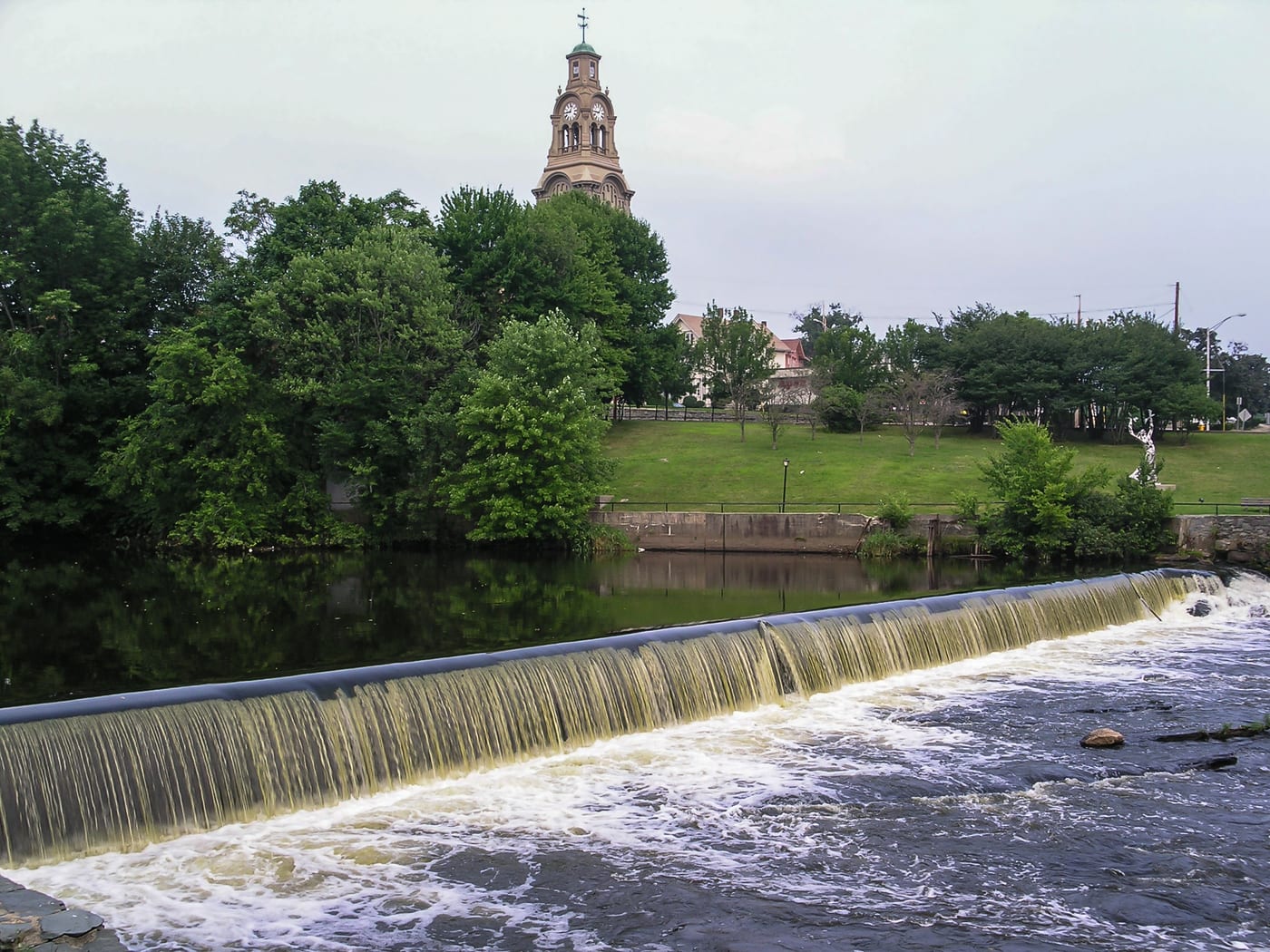
Old Slater Mill National Historic Landmark
The northern Rhode Island history stop that makes Blackstone Valley a real part of the state, not an afterthought.
Last checked
Sources
Reviewed source trail
- Blackstone River Valley National Historical Park — History & Culture (NPS) — checked 2026-06-27
- Slater Mill (Blackstone River Valley National Historical Park, NPS) — checked 2026-06-27
- Old Slater Mill (NPS Places) — checked 2026-06-27
- Going in Circles: A Revolution Along the Blackstone (NPS) — checked 2026-06-27
- First Strike Festival at Old Slater Mill — 200 Year Anniversary (NPS) — checked 2026-06-27
- Slater Mill — Wikipedia — checked 2026-06-27
- Samuel Slater — Wikipedia — checked 2026-06-27
- Pawtucket Textile Strike — Encyclopedia.com — checked 2026-06-27